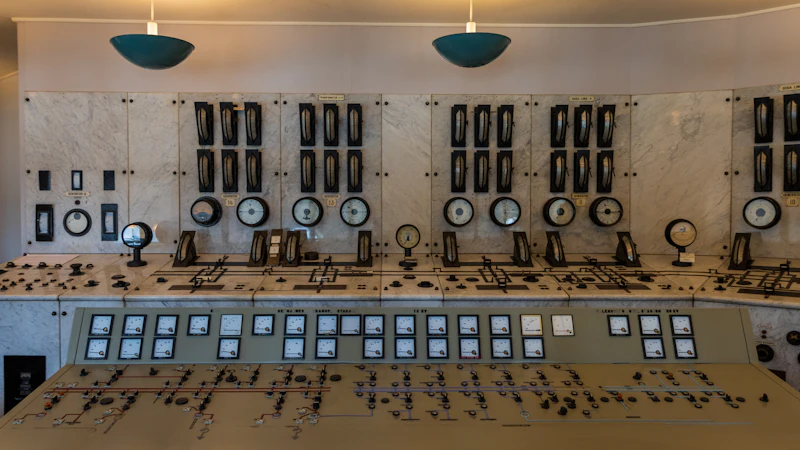
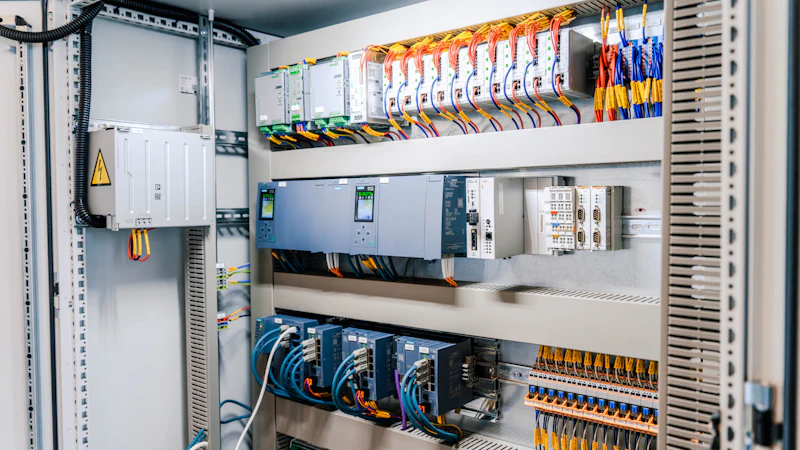
Electricity systems combine centralized control centers with hundreds or thousands of distributed sites. Security measures must protect that reach without compromising the availability and protection functions the grid depends on.
Sheet
Industry sheet
Sector
Energy and utilities
Representative systems
6
Typical challenges
5
Example
Illustrative
Industry context
Covers:
Power generation
Transmission and distribution
Grid substations and substation automation
Renewable energy and storage
Power systems are engineered for reliability: redundant paths, protection schemes that act in milliseconds and strict operating procedures. Cybersecurity has to fit that discipline rather than work against it.
Digital substations, remote engineering access and the growth of distributed renewable assets have increased connectivity. Each new connection is useful operationally and needs to be understood from a security perspective.
Reference architecture
Site A: Transmission substation
A control centre supervising a digital substation over a WAN, with IEC 61850 station and process buses. Select a zone to see its role, key risks and recommended controls.
Site ATransmission substationA control centre supervising a digital substation over a WAN, with IEC 61850 station and process buses.
L4 · IT
Enterprise IT
Business IT: email, ERP and corporate users. Treated as untrusted from the OT point of view.
Key risks
Phishing and ransomware spreading towards OT
Direct IT-to-OT connections
Shared credentials with OT
Recommended controls
No direct traffic to OT: all flows terminate in the DMZ
Buffer zone where IT and OT exchange data. Nothing passes straight through; every flow terminates here. Historian data is mirrored here for business users.
Key risks
Broad firewall rules added for projects
Unpatched shared services
Remote access bypassing the jump host
Recommended controls
Deny-by-default rules with documented justification
MFA on the jump host with session recording
Hardened, monitored DMZ servers
Assets: Jump host, Historian mirror, Patch / AV, DMZ switch Conduit up: Firewall, HTTPS, RDP via jump host
L3 · SL 3
Control centre (EMS / SCADA)
Grid operators supervise and control substations across the network.
Key risks
Compromise of the EMS affecting many substations
Weak authentication on operator consoles
Unvetted vendor access
Recommended controls
Role-based access and MFA for operators
Application allowlisting on servers
Logging forwarded to a monitored SIEM
Assets: SCADA / EMS, Operator WS, Historian, WAN router Conduit up: Firewall, OPC UA, historian replication
L2 · SL 3
Station level
Local supervision and the gateway that talks to the control centre. Engineering access to protection settings starts here.
Key risks
Engineering workstation used to change protection settings
WAN exposure of the gateway
Time source spoofing
Recommended controls
Substation firewall restricting WAN traffic to IEC 60870-5-104
Change control for protection settings
Authenticated time sources
Assets: Station HMI, Gateway / RTU, Engineering WS, GPS clock, Station bus Conduit up: Firewall, IEC 60870-5-104 over WAN
L1 · SL 3
Bay level
Protection relays and bay controllers that trip breakers in milliseconds.
Key risks
Unauthorized setting changes
Spoofed GOOSE messages
Default passwords on IEDs
Recommended controls
IEC 62351 security where supported
Per-user IED access and setting backups
Separate VLANs for GOOSE
Assets: Protection IED, Protection IED, Bay controller, Bay controller, Bay switch Conduit up: Direct, IEC 61850 MMS / GOOSE
L0 · SL 2
Process level
Primary equipment and the merging units that digitize measurements onto the process bus.
Key risks
Manipulated sampled values
Physical access to yards
Uncontrolled maintenance laptops
Recommended controls
Isolated process bus
Physical security and port control
Procedures for test equipment
Assets: Merging unit, Circuit breaker, Power transformer, CT / VT, Disconnector Conduit up: Direct, IEC 61850-9-2 sampled values, hardwired
A utility has added remote access to substations over several years through different projects. Each solution worked at the time, but nobody has a single picture of who can reach which station, and how.
Result
The utility gains a documented inventory of access paths, a list of paths to retire and a target design that can be rolled out station by station.
Structured approach
Collect remote access designs, firewall exports and vendor contracts.
Map every access path to the zones and assets it reaches.
Compare authentication, approval and logging across paths.
Recommend a consolidated access model and a phased migration.
This scenario is a hypothetical example of a common situation in the sector, not a description of OTVista client work.
Questions from energy and utilities teams
What makes substation cybersecurity different?
Substations combine protection functions with high availability requirements, distributed locations and long equipment lifecycles. Changes must respect protection engineering practice and outage planning.
Does IEC 62443 apply to power utilities?
IEC 62443 is widely used in the power sector alongside sector-specific standards such as IEC 62351 for communication security. Which references apply depends on your systems and regulator.
Can you work with renewable energy sites?
Yes. Wind, solar and storage sites share many concerns with other generation assets, often with more remote access and third-party operations.
We would like to use Google Analytics cookies to understand how visitors use otvista.com, so we can improve it. Analytics only runs if you accept. No advertising cookies are used. Cookie notice